


As Nobel Prize Goes to Venezuela’s Opposition Leader, Questions Arise Over How Far Trump Will Go to Support Her
As Nobel Prize Goes to Venezuela’s Opposition Leader, Questions Arise Over How Far Trump Will Go to Support Her
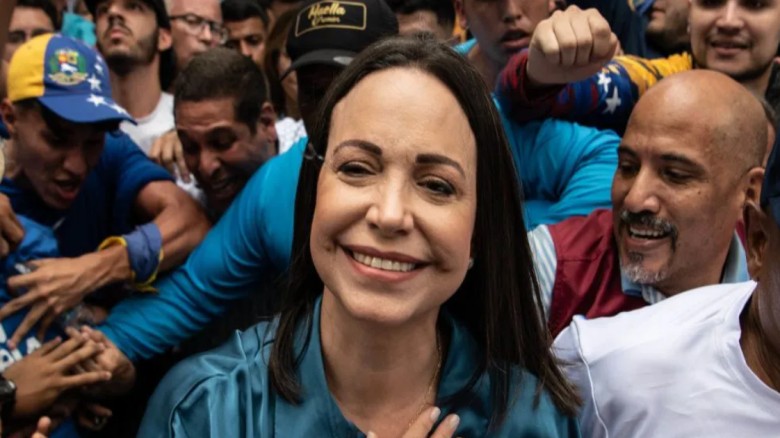
Caracas/Washington, October 10: The awarding of the Nobel Peace Prize to Venezuelan opposition leader María Corina Machado has reignited international attention on the country’s political crisis — and raised a pressing question: how far will former U.S. President Donald Trump go to support her?
The prize has been warmly welcomed by Venezuela’s opposition, who view it as a rare moment of global recognition in their long struggle against President Nicolás Maduro’s government. Responding to the honour, Machado directly appealed for help from Trump — the man who once believed he would win the Nobel himself.
“Today more than ever, we count on President Trump,” Machado said, urging the U.S., Latin American allies, and “democratic nations of the world” to help Venezuela “achieve freedom and democracy.”
A Nation in Crisis
Venezuela remains in deep turmoil. Millions live in poverty, basic utilities like electricity are unreliable, and the healthcare system is near collapse. Medicine shortages are widespread, and millions have fled to neighbouring countries or the United States.
The last national election was widely condemned as neither free nor fair, and post-election protests were brutally suppressed. Human rights organisations estimate that hundreds of political prisoners remain detained.
Opposition figures such as Edmundo González, whom the U.S. and its allies recognise as the legitimate president-elect, now live in exile. Machado herself is in hiding after being briefly detained at a protest in January.
With street protests fading amid fear of government crackdowns and the military still loyal to Maduro, the opposition’s path forward seems increasingly uncertain.
Rising U.S. Military Activity in the Region
Tensions between the U.S. and Venezuela have escalated dramatically in recent weeks. The U.S. military has bombed at least four boats off Venezuela’s coast, claiming they were drug-trafficking vessels. The strikes, carried out in international waters, killed at least 21 people.
Law experts have raised alarms that these attacks may violate international law. However, a leaked memo sent to the U.S. Congress suggests the Trump administration now classifies itself as being in a “non-international armed conflict”, a term used to justify wartime powers against cartels.
While drug cartels like Tren de Aragua do operate in Venezuela, the region is far from being Latin America’s largest trafficking hub — leading many to suspect the strikes serve a broader political purpose: putting military pressure on Maduro.
Reports indicate that the Pentagon has built up thousands of troops across the Caribbean, with special operations units spotted in nearby islands such as Trinidad and Tobago. Grenada’s government has confirmed reviewing a U.S. request to install radar equipment and technical staff at its main airport.
Venezuelan Defence Minister Vladimir Padrino López has accused the U.S. of preparing drone attacks and “selective assassinations”, while Colombia’s President Gustavo Petro warned that a “new war scenario” is emerging in the region.
Inside Venezuela, government-backed civilian militias are reportedly training in preparation for a potential U.S. intervention.
Washington’s Rationale and Political Stakes
Trump administration officials continue to portray Maduro as the head of a vast narcotics network. In August, the U.S. doubled its reward for information leading to Maduro’s capture to $50 million, accusing him of being “one of the world’s largest narco-traffickers” — a charge Caracas has dismissed as “pathetic.”
Despite limited cooperation from Venezuela on migrant repatriation flights, relations remain icy. Reports from The New York Times suggest that Venezuelan officials once offered the Trump administration a dominant stake in the nation’s oil, gold, and mineral industries — a deal Washington refused.
High-Risk Geopolitics
Any U.S. escalation would risk confrontation with Maduro’s key allies, including China, Russia, Iran, and Cuba, all of whom have publicly backed Venezuela’s sovereignty. Analysts warn that direct intervention could spiral into a major international crisis.
For now, Trump has expressed solidarity with Machado and Venezuela’s opposition while maintaining his tough stance against Maduro. But as the U.S. military footprint grows in the Caribbean, the world is watching to see whether Washington’s actions remain limited to counter-narcotics operations — or expand into a direct challenge to the Venezuelan government itself.
What began as a symbolic Nobel Prize may soon become a flashpoint in hemispheric politics, testing not only Venezuela’s fragile stability but also the extent of U.S. interventionism under Trump’s renewed leadership.


Leave A Comment