









Nationwide Trade Union Strike: Protests Held Across Punjab, Haryana, and Chandigarh
Nationwide Trade Union Strike: Protests Held Across Punjab, Haryana, and Chandigarh
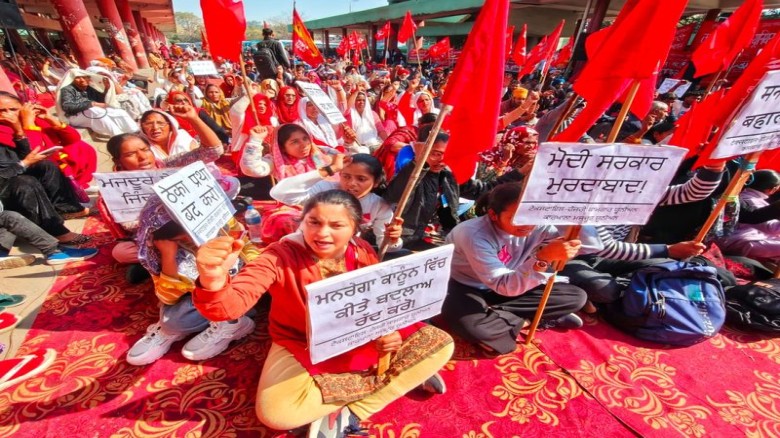
Chandigarh, February 13, 2026 – Employees and workers across Punjab, Haryana, and Chandigarh staged protests on Thursday, opposing the Centre’s labour reforms and economic policies. Organized by a joint forum of central trade unions, demonstrators called the government’s policies “pro-corporate” and demanded the withdrawal of new labour codes.
In Chandigarh, union members gathered at Sector 17, raising slogans against the government while holding placards reading “We reject labour codes” and “We oppose anti-labour codes.” The Punjab Bank Employees’ Federation (PBEF) also held a massive rally at Bharat Nagar Chowk in Ludhiana.
Protests were reported in several towns in Haryana, including Sonipat, Rohtak, and Hisar. While roadways buses and banks largely continued operations, trade union representatives said participation was significant, particularly in industrial areas like Manesar, Gurugram, Faridabad, Bawal, and Dharuhera. ASHA and Anganwadi workers joined the demonstrations as well.
Subhash Lamba, president of the All India State Government Employees Federation, said the strike received a “very good response” and affected multiple state departments, including Urban Local Bodies, power, tourism, irrigation, health, and revenue. State roadways employees also held a two-hour protest from 10 a.m. to 12 p.m. across various depots.
The nationwide strike, observed in states including West Bengal, Madhya Pradesh, Chhattisgarh, Kerala, and Tamil Nadu, called for the scrapping of four labour codes: the Code on Wages, 2019; Industrial Relations Code, 2020; Code on Social Security, 2020; and the Occupational Safety, Health, and Working Conditions Code, 2020. Unions also demanded the withdrawal of the Draft Seed Bill, Electricity Amendment Bill, and the SHANTI Act, as well as the restoration of MGNREGA and scrapping the Viksit Bharat Guarantee for Rozgar and Ajeevika Mission (Gramin) Act, 2025.
PBEF General Secretary PR Mehta said the new labour codes restrict the right to strike and encourage contractual employment, making jobs insecure by simplifying hiring and firing. “Through united and democratic action, workers across sectors will strongly oppose these changes,” Mehta added.
Trade union leader Dr. Rajinder Pal Singh Aulakh warned that most workers could be excluded from labour law protections, leaving them vulnerable to exploitation. Naresh Gaur, PBEF Ludhiana secretary, stated that the new codes benefit big corporations at the expense of workers’ welfare and social security. He urged the government to engage in dialogue with unions, halt privatisation, and reconsider recent policies, including the 100% FDI hike in insurance.
The joint forum representing the protests includes major unions such as the Indian National Trade Union Congress (INTUC), All India Trade Union Congress (AITUC), Hind Mazdoor Sabha (HMS), Centre of Indian Trade Unions (CITU), All India United Trade Union Centre, Self Employed Women’s Association, All India Central Council of Trade Unions, Labour Progressive Federation, and United Trade Union Congress.
Police were deployed in multiple locations to maintain law and order during the demonstrations, which reflect growing unrest among workers over the government’s labour and economic policies.


Leave A Comment